The discovery section of an agency pitch used to be built by hand, from desk research and close reads of a prospect's coverage. AI has changed how agencies write content and read audiences, so business development has to change with it, and the research behind the discovery section is the obvious place to start.
How did agencies build a discovery section before AI?
For most of my decade in communications, a discovery section meant desk research. We read a prospect's coverage to see how its target media positioned it, did the same for its competitors, and then worked out the white space from our own reading of the news cycle.
Nobody had a reliable dataset on what audiences were actually looking for, which left real room for new ideas and experimentation. The creative strategist's judgement carried the pitch, and storytelling was valued because it was doing work that no data could do at the time.
Content moved more slowly as well. Brands published less often, each piece was more targeted and more carefully considered before distribution, and the lead time between an idea and its release to market was far longer than it is now.
What has AI changed for agencies?
Agencies now use AI tools to draft content and audience intelligence tools to see what people are searching for and how to shape messages to reach them. Because the way agencies write and understand audiences has changed, the way they win new business has to change as well.
Clients have noticed the shift, and in my experience more of them now want to partner with agencies that are AI-forward. They want teams whose tools let them do more with a smaller budget, and their expectations rise each time AI makes something faster or cheaper.
The largest holding companies, WPP and Publicis among them, have put substantial investment into their own AI suites. Boutique, specialist and mid-tier agencies with growth in mind cannot match that spending, so business development is where AI needs to pay off for them first.
Why does the discovery section still take so long?
Most agencies already back their discovery sections with audience insight and analytics tools. The research still takes time, because each of those tools stands alone and needs a user who knows how to prompt it and how to read its output against the news cycle.
Someone has to pull the search data, read the coverage, compare the competitors and decide which themes are open, and that person is usually mid to senior, because the value sits in the judgement. The tools speed up each step, but they leave the joining-up to a person.
The question we asked when building Harbor AI was whether that joining-up could be automated. If a tool could carry the context a mid to senior strategist brings, the discovery section would start out targeted and relevant to what the prospect is actually looking for.
What does Discovery in Harbor AI do?
Discovery reads a prospect's own posts and press from the last 90 days and its competitors' posts from the last 12 months. It scores every theme against search demand and news coverage, then drafts deck sections you can paste straight into a pitch, with every figure sourced.
To show how it fits a real process, we ran it on AIA Hong Kong.
How the prospect is positioning itself
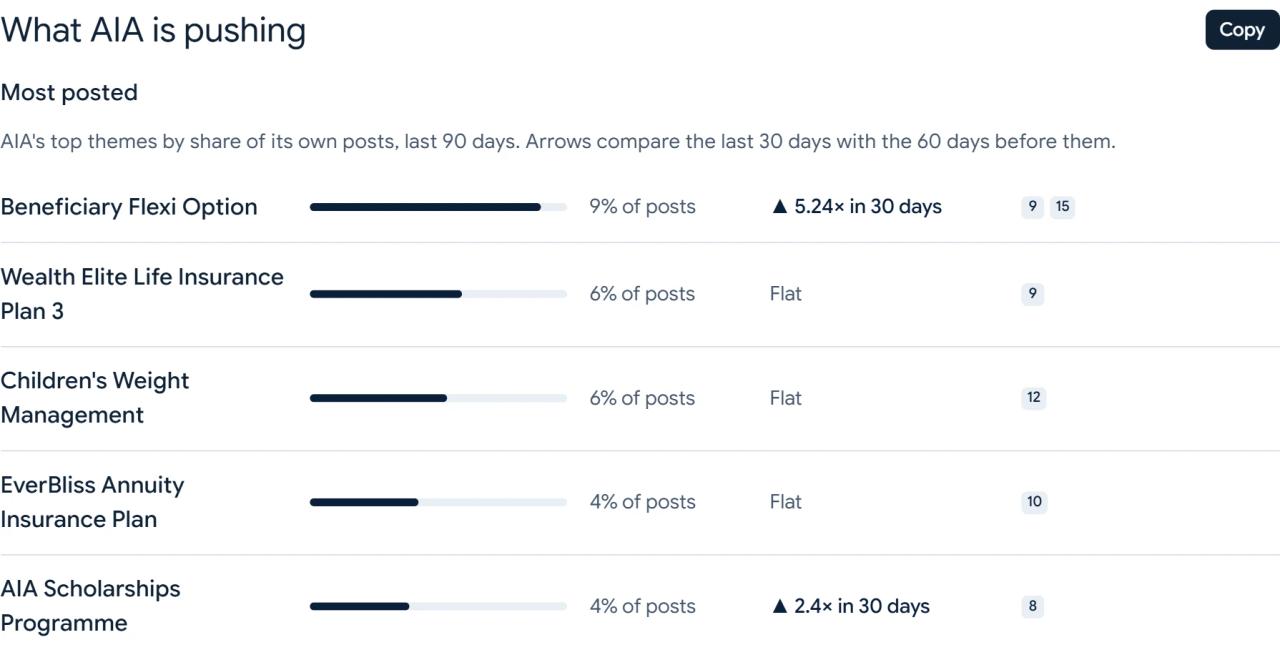
The first panel ranks the themes in the prospect's own posts by their share of its output and shows what has risen in the last 30 days, with every row linked to the posts behind it. It replaces the coverage read we used to do by hand, and it gives you the prospect's own words to set against the brief.
In the AIA run, posts about one product feature, the Beneficiary Flexi Option, took a share 5.24 times higher in the last 30 days than in the 60 days before. A shift like that is worth raising in a chemistry meeting, because the answer often shows what the business is prioritising this quarter.
Where the white space is
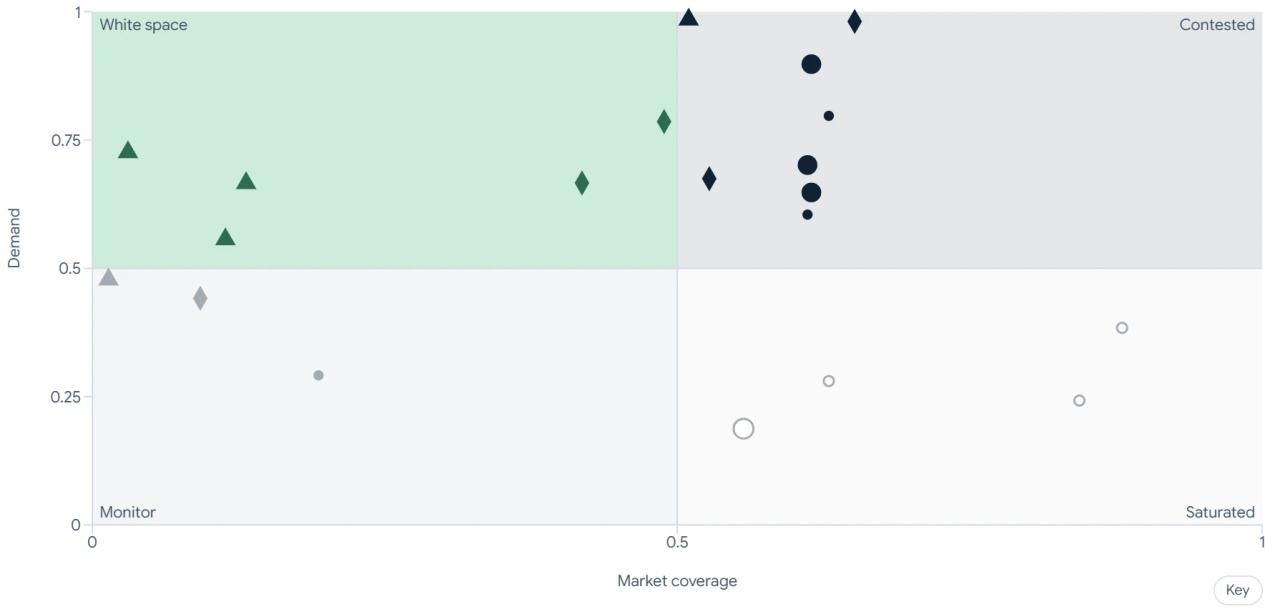
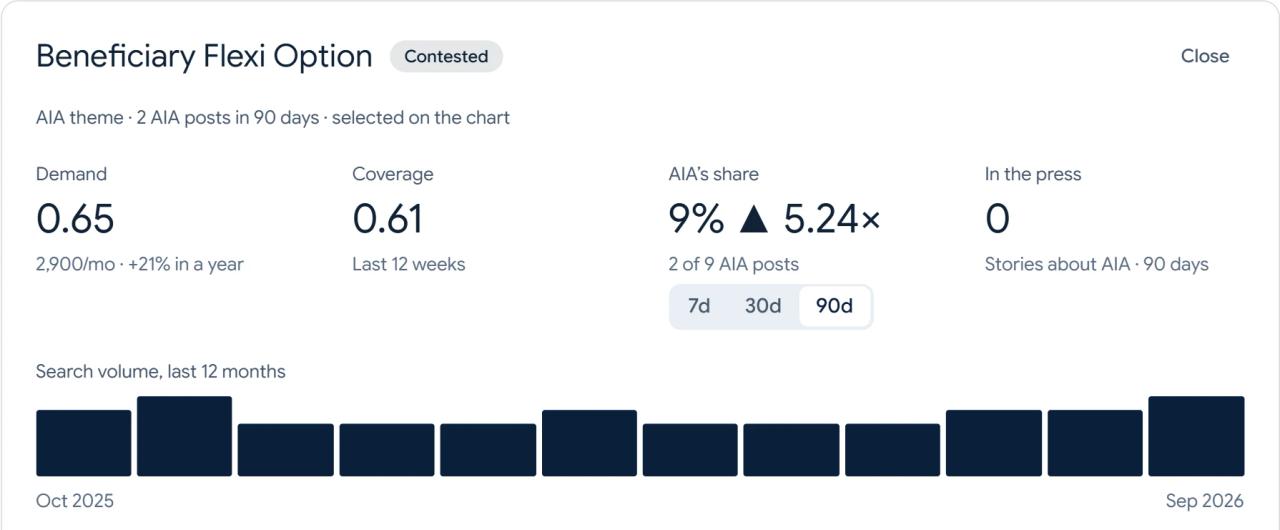
Every theme then sits on a map of search demand against news coverage, so the white space we used to judge from our own reading of the news cycle is now plotted for us. Opening a theme shows its demand, a year of search history, its coverage, the prospect's share and its press mentions, with the source quotes underneath.
The strategist's judgement still matters at this point. The map shows where attention is unmet, and the strategist decides which of those openings fits the prospect's story and which idea will carry it.
How the competitors are positioned
Peer lists can be added in addition to the prospect. Their themes join the same map, and anything only a rival covers is marked as competitor only.
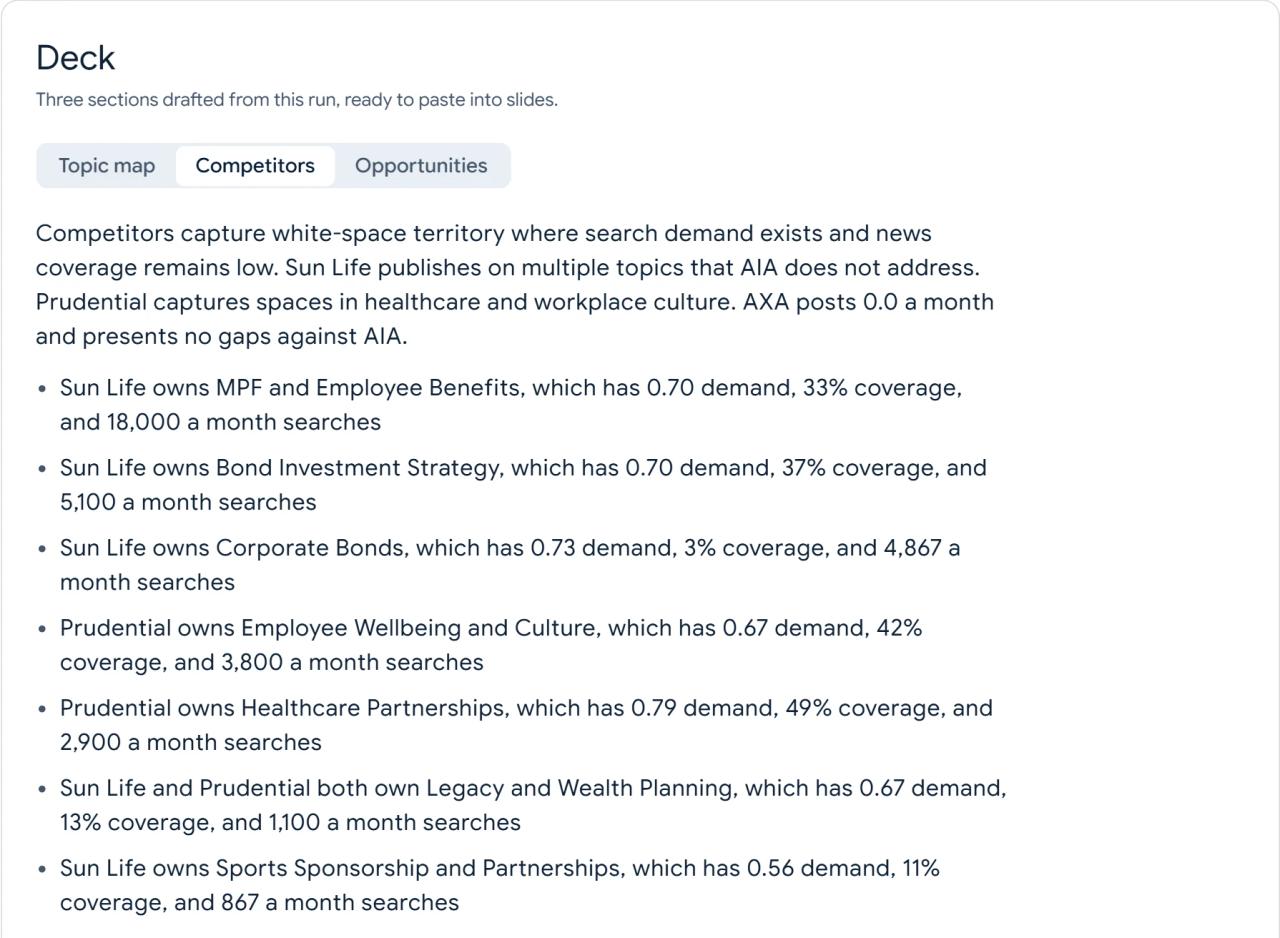
With Sun Life, Prudential and AXA added, the AIA run surfaced themes such as workplace benefits and wealth planning, which the rivals post about and AIA's recent posts did not cover. This is the comparison we used to build by hand from each competitor's coverage, and it now arrives on the same map as the prospect's own themes.
From research to the deck
Once scoring finishes, Discovery drafts three sections (a topic map, the competitor gaps and the opportunities) with a sources list underneath, and each one pastes into PowerPoint, Google Slides, Docs or Canva. Code calculates every figure, and a guard removes any drafted sentence whose number or quote is not in the stored facts.
Treat the result as the first draft of your discovery section. The team still writes the story, but it starts from evidence that took 16 minutes to gather for AIA and three competitors.
What does this mean for agencies chasing growth?
For a boutique or mid-tier agency, automating the research behind a discovery section is a practical way to work like an AI-forward partner without a holding company's budget. The senior hours that used to go on desk research can go back into the idea and the relationship.
The same run works for clients you already hold. Running Discovery before a quarterly review, with the rivals the client worries about, brings fresh evidence into the conversation and helps keep a retainer from shrinking into a string of projects.
Creativity still wins pitches, as it did before any of these tools existed. The difference is that the creative strategist can now begin from what audiences are searching for and what the press has left open, instead of spending the pitch fortnight assembling that picture by hand.
Key takeaways
- Business development has to change because the way agencies write content and read audiences has already changed.
- Separate audience tools still leave the joining-up to a mid to senior person, which is where the hours go.
- Use the prospect's own themes, set against the brief, to find your opening question for the chemistry meeting.
- Add the competitors the client watches to find the themes the prospect has left to its rivals.
- Paste the drafted sections as a first draft, check every name and figure, and spend the saved hours on the idea.
What is Harbor AI?
Harbor AI is an AI visibility (AEO and GEO) and content platform for PR agencies and communications teams, built by Harbor Group in Hong Kong. It tracks how five AI engines answer buyer questions about a brand, shows which topics audiences want and the press has left open, and drafts cited fixes from the brand's own materials. See how it works.