Most of the AEO advice I've read this year is SEO with a new label. Same keyword lists, same content calendars, same dashboards, now with "AI" in the deck title. I understand the instinct. It's comfortable to treat a new channel as an old one in fresh packaging. It's also the quickest way to become invisible.
Here is the shift as I see it. When an executive asks ChatGPT or Perplexity who they should hire to reposition a brand, or what the real risks of entering a market are, they don't scroll through ten blue links. The engine reads the web on their behalf, weighs what it finds and hands back one answer. Your first reader is no longer a person. It's a model deciding whether you are the obvious answer.
That changes the job. You're not trying to win a click any more. You're trying to win the consensus.
Say something new, or don't expect to be cited
Search rewarded presence. Publish enough pages around a keyword and some of them would rank. Answer engines work differently. They condense dozens of sources into a single response, and a source that repeats what everyone else says adds nothing to that response. There's no reason to cite it.
The test I use is information gain: what does this piece tell a reader that they couldn't get anywhere else? For most corporate content (the rewritten press release, the "ultimate guide", the annual trends listicle) the honest answer is nothing.
What earns a citation is material the model can't find elsewhere. Your own data. A benchmark from your client work. A named method. A clear position you're prepared to defend in public. Hedged writing is hard to quote, and "it depends" is rarely the answer an engine chooses to give.
This is the problem we built Harbor AI around. Its opportunity map plots every keyword in your material by audience demand (how much people search for it) against coverage (how much the press already writes about it). The gaps, topics people want that nobody has covered properly, are what we call whitespace. In practice, whitespace is information gain you can measure before you write a word.
Your website is one voice in a crowded room
Most teams I talk to still spend the bulk of their AEO effort on their own site: schema, page speed, FAQ blocks. That work matters, but it's the smallest part of the picture.
Models form their view of you from the open web: Reddit threads, Hacker News comments, GitHub issues, industry forums, podcast transcripts. If the only place your company is described is your own homepage, the engine has one interested source and little reason to trust it. If real people discuss you in the places models read, you start to look like a fact.
This is where communications people have an advantage, if they use it. Third-party validation was always the job. What's changed is the audience. You used to pitch a journalist to reach their readers. Now every credible public mention is evidence the model weighs. The work shifts from landing one big hit to being discussed, accurately and often, in many places at once.
Write for two readers
Marketing copy was built for people who skim and forgive vagueness. "Next-generation." "Disruptive." "End-to-end solutions." A human fills in the gaps. A model can't do that reliably. Vague copy gives it nothing concrete to repeat, and it may fill the gap with something that isn't true.
So write in two layers. For the person, write with a voice and an argument. For the engine, make sure every question a buyer asks has a direct, self-contained answer: what you do, who it's for, how you work, what makes you different. A discipline that works well is to answer each one in 40 to 60 words that still make sense when lifted off the page, then back it with schema markup so there's no doubt about what the page says.
Concrete beats clever here, and concrete usually means sourced. In Harbor AI, a review shows which topics a press release or op-ed leans on and which it underplays. The fixes that follow are paragraph-level edits built from your own materials, each one cited to the document it came from. Done properly, the two layers don't compete. Clear writing reads better to people too.
Content now has a shelf life
The annual report that sits untouched for twelve months was always a weak asset. With answer engines, it decays faster. They lean towards recent sources, so a page nobody has touched in a year starts at a disadvantage against one updated last month.
The fix is to run communications the way a software team ships product: small, frequent releases to the public record about you. Refresh the numbers. Add the new case study. Retire the claim that no longer holds. Date your updates honestly. Freshness isn't a campaign. It's maintenance.
How we measure whether you're the answer
Impressions and click-through still tell you something, but they miss the question that matters now: when a buyer asks an AI about your category, are you in the answer, and is it right?
That is the question AI visibility in Harbor AI answers. You set the questions your buyers actually ask. Harbor puts each one to seven engines (ChatGPT, Gemini, Google AI Mode, Google AI Overviews, Perplexity, Microsoft Copilot and Claude) several times over, because the same engine rarely gives the same answer twice. Then it repeats the read every week. Each read reports four things:
- Named in: how many answers mention you at all, and how that has moved since the last read.
- Cited and linked: whether the engine credits your content as a source, and whether it links to you.
- Share of voice: who gets named instead of you, and how often.
- Top cited domains: which sites the engines lean on for your category, yours and everyone else's.
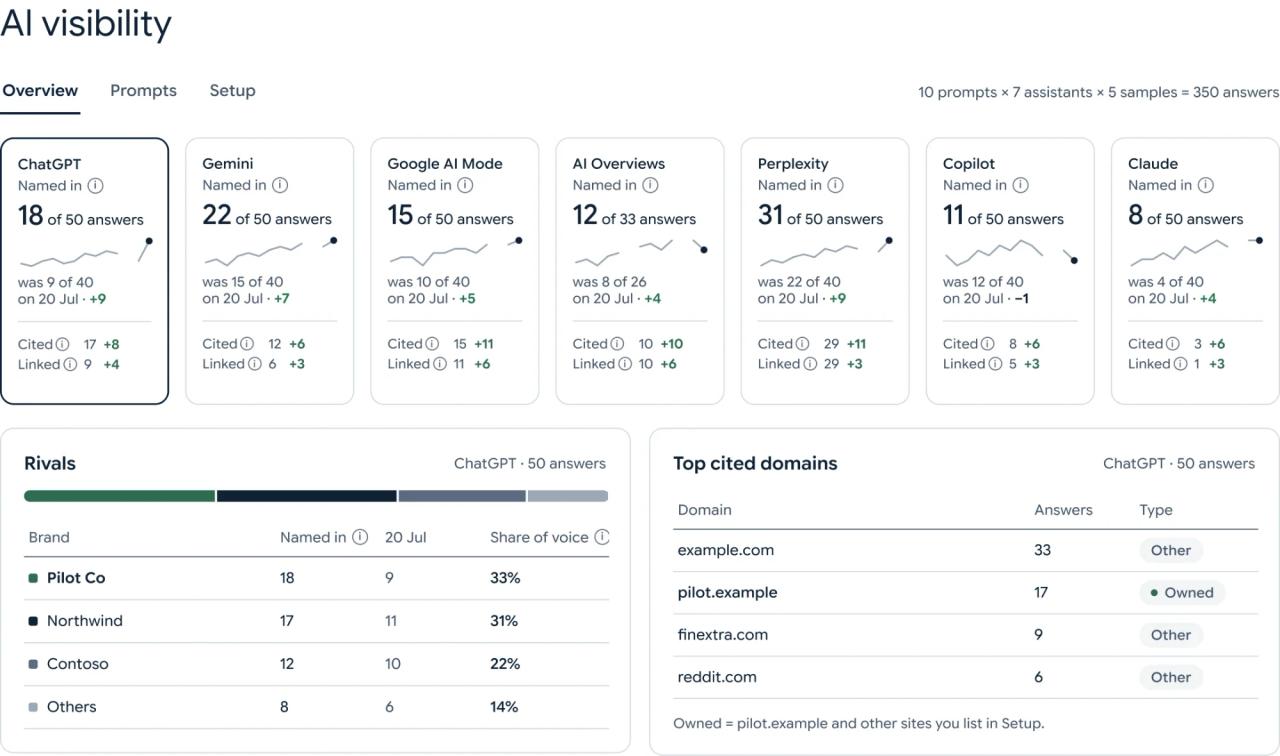
For me the domains table is the most useful view. It makes the earlier point concrete: your own site is one entry, and the rest of the list (trade press, forums, Reddit) is where the consensus gets built. It also tells you where your next piece of coverage should land.
Most GEO trackers stop at the score. We built Harbor to go a step further: it shows where a brand is missing from AI answers, then drafts the fix from the brand's own materials, fully cited. For agencies, that turns AI visibility into a service you sell rather than a report you send.
Your next client may never visit your website before they call you. They'll have asked an assistant first, and it will already have a view. A 2024 playbook of impressions and link clicks won't move that view. Original work, discussed widely, written clearly and kept current will. Stop optimising for the algorithm. Become the answer it can't argue with.
What is Harbor AI?
Harbor AI is an AI visibility (AEO and GEO) and content platform for PR agencies and communications teams, built by Harbor Group in Hong Kong. It tracks how seven AI engines answer buyer questions about a brand, shows which topics audiences want and the press has left open, and drafts cited fixes from the brand's own materials. See how it works.