The AI tools worth paying for in a PR agency are the ones that serve one of three goals: serving clients better without adding headcount, winning new clients, and freeing senior people from routine work so they can focus on strategy. From media monitoring to business development, we look at the tools that get the job done.
What do PR agencies need AI tools to do?
Most agency leaders I speak to are working towards the same three goals, and every tool in their stack should earn its place against at least one of them:
- Serve clients better and widen the service offer without investing heavily in new hires.
- Grow the client base, which means winning more of the pitches the agency enters.
- Give people time for strategy by taking the reading, compiling and first drafting off their desks.
Those goals map onto four priorities in day-to-day agency work: news and media monitoring, journalist intelligence, content development, and business development.
Which AI tools handle news and media monitoring?
From my junior days at Burson to working for younger boutique agencies, media monitoring has always been an essential service for clients. Meltwater, Signal AI, and CARMA are staples I've used to varying effect (I do have a favourite). These tools have levelled up with AI visibility, and they have expanded and automated their services to make better use of practitioners' time.
| Tool | What its own pages say | Strongest for |
|---|---|---|
| Meltwater | Global media and social monitoring, with GenAI Lens tracking how brands appear in ChatGPT, Gemini, Perplexity and Claude | Agencies that want one global platform with AI visibility included |
| Signal AI | Reputation and risk intelligence using licensed content from Dow Jones, Bloomberg and LexisNexis in more than 120 languages, plus LLM and AI search monitoring | Enterprise clients managing reputational risk |
| CARMA | Monitoring and evaluation in more than 105 languages, with AI Visibility across six AI assistants and an AI analyst called Noor | Agencies where measurement and evaluation are a core service |
These platforms answer the question of where a client stands. They report what was said, how often and with what sentiment, and the strategist still decides what the client should do about it.
Which tools give agencies better journalist intelligence?
Telum is close to universal among agencies in APAC, and it's as essential to PR as Google is to, well, everyone. It's the first stop for practitioners looking to pitch journalists, and it recently announced a partnership with Truescope that combines Truescope's AI-powered media intelligence with Telum's journalist and media relations database.
Muck Rack has added an AI angle to the same job. Its AI Visibility Badges rate journalists and outlets by how often AI answers cite them, which helps an agency choose coverage that is more likely to reach the AI engines its clients care about.
Can general AI assistants handle content development?
General assistants such as ChatGPT, Gemini, Claude and Copilot draft quickly, and most agencies already use them. Their limits show up in client work: the drafts lack the client's context, need heavy editing to reach a client's standard, and have no view of what the target audience is actually searching for.
In my experience, copy from a general assistant often ships with the tells readers now recognise, including stock phrases, an even rhythm and claims with no source behind them. Clients notice those tells, and an agency that sends them out loses the polish that justifies its fee.
Harbor AI takes a different approach to the same job. It reads a draft press release or op-ed against the client's own documents and scores every topic by audience search demand against how much the press already covers it, then suggests paragraph-level edits drawn from the client's material, each one cited to its source document.
The edits sit in a review editor where the writer accepts, rejects or rewrites each one, so the agency keeps its voice and its judgement. Harbor also tracks how five AI engines answer buyer questions about the client each week, which tells the team whether the content is changing how the brand appears in AI answers.
Is there an AI tool for PR business development?
Perhaps the biggest missing piece in the PR agency tech stack is a tool built for growth. Business development is a non-optional but cumbersome task that practitioners at every level have to balance with their day-to-day client work. Having pitched some of the biggest brands in the world and spent hours on decks, I know exactly what makes a winning pitch deck.
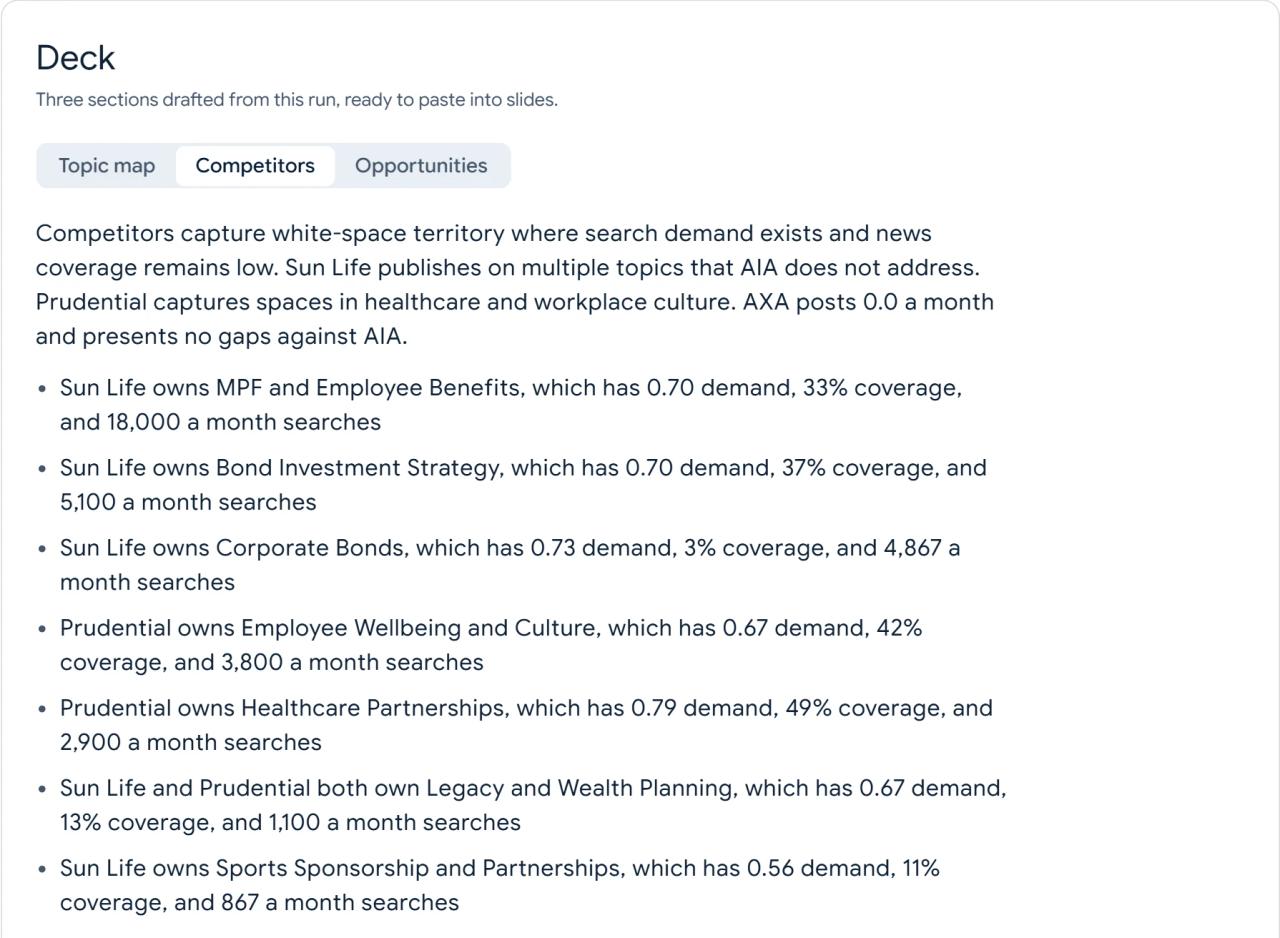
Discovery in Harbor AI is built for that job. It takes a prospect's name, website and news edition, reads its own posts and press from the last 90 days and its competitors' posts from the last 12 months, and scores every theme against search demand and news coverage. It then drafts the sections a pitch needs (a topic map, the competitor gaps and the opportunities), each ready to paste into slides with its sources listed.
When we ran it on AIA Hong Kong, with Sun Life, Prudential and AXA as competitors, the platform produced the research a strategist used to assemble by hand for a pitch's discovery section. I walk through that run step by step in our article on how AI is changing the discovery section of an agency pitch.
How do these tools map to an agency's goals?
Each priority serves at least one of the three goals, and the table below shows where each tool earns its place. Most agencies will run one tool from each row rather than one tool for everything.
| Priority | Tools to weigh | Goal it serves |
|---|---|---|
| News and media monitoring | Meltwater, Signal AI, CARMA, Brandwatch | Serve clients better, including AI visibility reporting, without adding analysts |
| Journalist intelligence | Telum Media, Muck Rack | Free people for strategy by keeping contact research current |
| Content development | General assistants for quick drafts, Harbor AI for audience-scored review and cited edits | Serve clients better and free people from first drafts |
| Business development | Harbor AI Discovery | Grow the client base by researching prospects before the pitch |
Key takeaways
- Judge every AI tool against the three goals of better service, more clients and more time for strategy.
- Use a monitoring platform to add AI visibility reporting to the service without hiring an analyst for it.
- Choose a journalist database for the markets you pitch in, and keep its profiles at the centre of outreach.
- Ground client content in the client's own documents and in audience data, and check every draft for the tells of AI writing before it ships.
- Give business development a tool of its own, so prospect research stops depending on a senior person's spare evenings.
Frequently asked questions
Does Harbor AI replace Meltwater or a journalist database like Telum?
Harbor AI sits beside both. It does not monitor broadcast or print media or hold journalist contacts, so an agency still needs a monitoring platform and a database, and Harbor adds content review, cited edits, AI visibility and prospect research on top.
Can ChatGPT or Gemini write client-ready press releases?
General assistants write a fast first draft, but they work without the client's documents or data on what the audience searches for. Agencies get better results when the draft is checked against the client's own material and audience demand before a writer polishes it.
Is there an AI tool for PR agency business development?
Discovery in Harbor AI is built for it: it researches a prospect's posts, press and competitors and drafts the discovery section of a pitch, with every figure sourced. We have not found another tool that describes this workflow on its product pages.
What is Harbor AI?
Harbor AI is an AI visibility (AEO and GEO) and content platform for PR agencies and communications teams, built by Harbor Group in Hong Kong. It tracks how five AI engines answer buyer questions about a brand, shows which topics audiences want and the press has left open, and drafts cited fixes from the brand's own materials. See how it works.